If you’re just joining us, here is our main story with all the key developments:
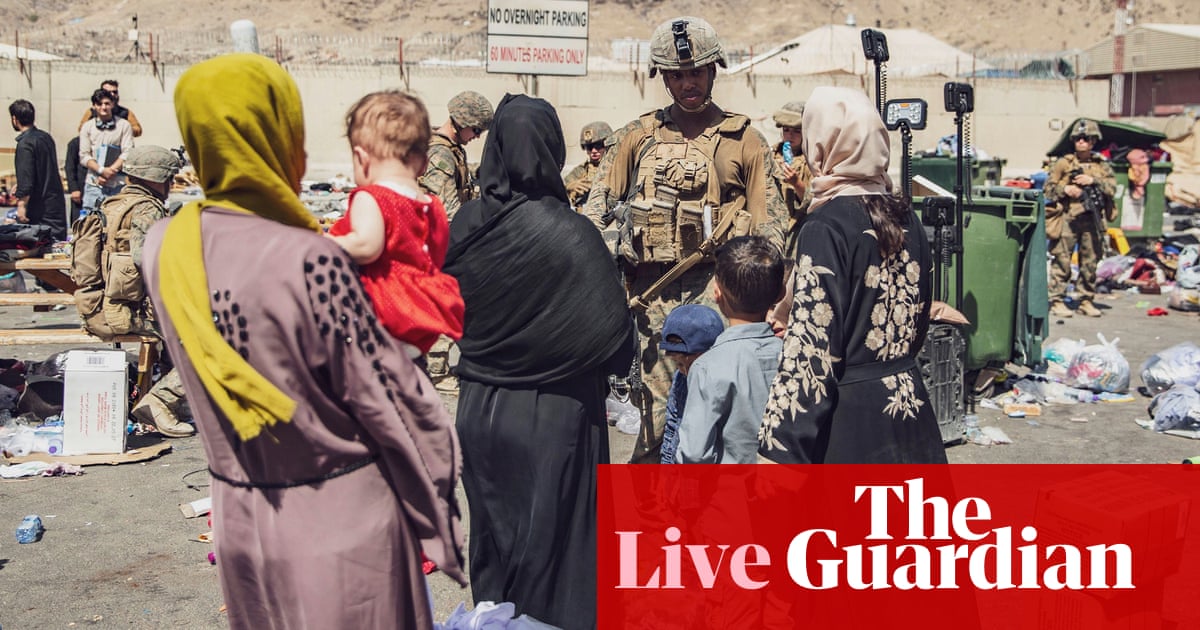
The US remains on high alert for another possible terror attack at Kabul airport and has warned citizens to “immediately” leave the area, as military forces moved into the final stage of evacuations from Afghanistan and the Taliban signalled its readiness to take over.
The US embassy in Kabul on Sunday issued an alert – its second in as many days – of security threats at specific areas of the airport, including access gates. It followed an earlier warning from president Joe Biden that another terror attack in Kabul was “highly likely”.
Biden said the US drone strike that killed two Islamic State targets in retaliation for the deaths of 13 US service members and as many as 170 civilians on Thursday would not be the last such action.
The president has also said he will stick by his Tuesday deadline to withdraw all troops from Afghanistan. On Sunday, a Western security official in the Afghan capital told Reuters just over 1,000 civilians inside the airport remain to be flown out before troops are pulled out:
The Observer’s editorial today argues that “Afghanistan is a tragedy, a parable and a cautionary tale for our age.”
As the last, desperate evacuees scramble aboard planes in Kabul, as suicide bombers threaten to kill yet more blameless people, as a vast tide of refugees inundates the border with Pakistan and as the remaining population cowers, trapped and in fear before a resurgent Taliban, all those in the west who fought for 20 long and bloody years to shape this country’s future must pause, stand back and ask themselves: what have we done?
Since the al-Qaida attacks on US cities on 11 September 2001, which triggered a global convulsion, remote, impoverished Afghanistan has touched, influenced and tested every great question, every big idea and movement – ideological, religious, geo-strategic – of our times. Many, for example, will view this staggering defeat, which is how history will surely judge it, as primarily a defeat for the problematic western concepts of humanitarian intervention and a rules-based world order.
It’s undeniable that significant, even inspirational advances were made as the Nato allies acted out their theories of nation-building. Generations of young Afghans gained an education. Careers opened up to girls and women. Healthcare was available to rural villages where none previously existed. Free media and free speech flourished. A crude, vital democracy took shape. These are proud achievements.
For Republicans it was a day of thoughts and prayers – and political opportunity.
When a suicide bombing in Kabul on Thursday killed 13 US troops and dozens of Afghan civilians, Republicans were careful to begin their official responses by paying tribute to the heroism of the fallen. Some, however, went on to demand the resignation of the commander-in-chief.
“It’s not a day for politics,” responded Jen Psaki, the White House press secretary.
But in truth the politicking had already begun, indicating how Republicans intend to exploit the Afghanistan crisis to diminish Joe Biden and defeat him at the polls.
The president’s decision to withdraw US forces by the end of August precipitated the collapse of the Afghan government and army far quicker than he predicted, a takeover by the Taliban and a chaotic evacuation. Biden has expressed no regret or remorse, noting that after 20 years there is little public support for continuing America’s longest war.
But Republicans smell blood, having until now struggled to find an effective line of attack against Biden as candidate or president. Although foreign policy rarely decides US elections, the critiques have fuelled a pre-existing narrative that the 78-year-old does not have “the right stuff”:
By Wednesday morning the last US troops will have left Kabul and the day will break on a country entirely controlled by the Taliban, the last shadow of American threat banished.
It is still uncertain what this second iteration of the caliphate will look like, but with foreigners finally gone, the shape of the new Afghanistan will come into sharper focus.
The Taliban have made clear they want to avoid a repeat of their 1990s rule when they presided over an international pariah state, mismanaged the economy and increased repression as discontent spread. What is less clear is whether they can achieve that, or how they will attempt it.
The pivot from fighting an insurgency to managing the government was always going to be difficult, and the Taliban have had less time to prepare than they expected. The speed with which Kabul fell caught even the Taliban by surprise, co-founder Mullah Abdul Ghani Baradar has admitted, and it is clear the group had not yet pinned down who would rule, and how:
On Saturday in Kabul, hundreds of protesters, including many civil servants, gathered outside a bank while countless more lined up at cash machines, AP reports. They said they hadn’t been paid for three to six months and were unable to withdraw cash. ATM machines were still operating, but withdrawals were limited to about US$200 every 24 hours.
Later Saturday, the central bank ordered commercial bank branches to open and allow customers to withdraw $200 per week, calling it a temporary measure.
The economic crisis, which predates the Taliban takeover, could give Western nations leverage as they urge Afghanistan’s new rulers to form a moderate, inclusive government and allow people to leave after Tuesday.
Afghanistan is heavily dependent on international aid, which covered around 75% of the toppled Western-backed government’s budget. The Taliban have said they want good relations with the international community and have promised a more moderate form of Islamic rule than when they last governed the country, but many Afghans are deeply skeptical.
The Taliban cannot access almost any of the central bank’s US$9bn in reserves, most of which is held by the New York Federal Reserve. The International Monetary Fund has also suspended the transfer of some US$450 million. Without a regular supply of US dollars, the local currency is at risk of collapse, which could send the price of basic goods soaring.
Boris Johnson has responded to criticism that the rapid withdrawal from Afghanistan has undermined Britain’s 20-year involvement in the country, by telling those who served that the gains made there will not “swiftly be undone”.
In an open letter to current and former military personnel, the prime minister said they “should take the greatest pride” in their achievements in Afghanistan since the 2001 US-led invasion. He said they had succeeded in the “central mission” of keeping the UK safe from attacks masterminded from the country:
A former Royal Marine who founded an animal shelter in Kabul left an expletive-laden message for a government aide as he sought to place his staff and pets on a flight out of Afghanistan, according to reports.
The Times newspaper said it had obtained a leaked audio recording of Paul “Pen” Farthing berating Peter Quentin, a special adviser to the defence secretary, Ben Wallace, who he accused of “blocking” efforts to arrange a flight.
Farthing’s campaign to get workers and animals from the Nowzad shelter out of Afghanistan has caused controversy in recent days, after receiving a huge amount of public support.
Although visas were granted for his 24 staff and their dependents, Farthing refused to leave without his pets and aimed to get 200 dogs and cats out of the country.
On Friday, the Ministry of Defence (MoD) announced that the ex-marine and his animals were at Kabul airport and clearance for their charter flight had been sponsored by the UK government.
In the recorded message, reportedly sent on Monday, Farthing threatened to “destroy” Quentin on social media if he did not help arrange the evacuation:
More now on those comments from a Western security official at the airport, via Reuters:
US forces are in the final phase of their evacuation from Kabul and just over 1,000 civilians inside the airport remain to be flown out before troops are withdrawn, a Western security official in the Afghan capital said on Sunday.
The official, who asked not to be identified, told Reuters a date and time for the end of the operation was yet to be decided. US President Joe Biden has said he will stick by his Tuesday deadline to withdraw all troops from Afghanistan.
“We want to ensure that every foreign civilian and those who are at risk are evacuated today. Forces will start flying out once this process is over,” said the official, who is stationed at Kabul airport.
The Taliban, Afghanistan’s new rulers, and the departing US forces are aiming for a swift handover of Kabul airport, a Taliban official told Reuters on Sunday.
“We are waiting for the final nod from the Americans to secure full control over Kabul airport,” the official said on condition of anonymity.
He said the militants, who seized control of the capital on 15 August after a lightning advance against the Western-backed government, had a team of technical experts and highly qualified engineers ready to take over the airport.
On the subject of UK evacuations of Afghans: thousands of emails to the Foreign Office from MPs and charities detailing urgent cases of Afghans trying to escape from Kabul have not been read, including cases flagged by government ministers, the Observer has been told.
The UK’s Afghanistan evacuation concluded on Saturday night with the departure of Britain’s final military and diplomatic personnel, bringing a sudden end to the 20-year deployment. More than 15,000 people have been brought out of the country in the last fortnight, in what ministers described as the largest UK military evacuation since the second world war.
However, amid accusations of government incompetence over elements of the evacuation effort, the Observer has seen evidence that an official email address used to collate potential Afghan cases from MPs and others regularly contained 5,000 unread emails throughout the week.
Michael Savage, Hannah Ellis-Petersen and Emma Graham-Harrison report:
In the UK, Labour has accused Government ministers of being “missing in action” during the Afghanistan crisis as the blame game over the handling of the withdrawal after a 20-year campaign in the country began.
The Sunday Times reported that fingers were being pointed at the Foreign, Commonwealth and Development Office over a lack of escape routes from the country, with claims that up to 9,000 people who may have been eligible to escape – such as women, journalists, and aid workers – were left behind.
Defence Secretary Ben Wallace previously said he believed there were between 800 and 1,100 Afghans eligible under the Afghan Relocation and Assistance Policy (Arap) scheme who would be left behind, while around 100 and 150 UK nationals will remain in Afghanistan, although Mr Wallace said some of those were staying willingly.
But MPs have said that judging by their correspondence, they thought the true numbers were far higher.
Citing an unnamed Western security official, AP reports that the crowd waiting outside Kabul airport’s gates has thinned out following the warning of a “specific, credible” threat issued by the US embassy in the early hours of Sunday morning.
The official said that evacuations have entered their final phase, with 1,000 people – the AP alerts do not specify which nationalities – currently inside the airport and awaiting flights.
Croatian police say 19 Afghan citizens evacuated from their country because of the threat from the Taliban have landed in Croatia, AP reports.
A police statement says the group arriving Saturday evening included three families with 10 children and a single man.
Police say the evacuees are people with links to the European Union delegation in Kabul and their families and have expressed intent to seek asylum in Croatia.
They will be housed in a camp for vulnerable groups since they include minors. No other details are immediately available.
from WordPress https://ift.tt/3BmkuZR
via
IFTTT
